
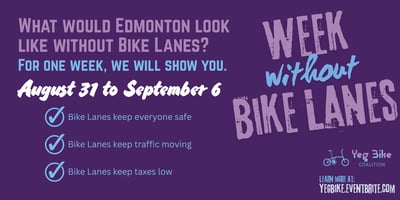
For one week, we're going to show you. August 31 to September 6, 2026. Bike lanes are often...
You Don't Have to Ride a Bike to Benefit From Bike Lanes
We hear people asking why they should want bike lanes if they don't cycle around Edmonton. Let's address that by asking why our 2027–2030 budget requests are good for Edmonton, including people who never cycle.
Edmonton is preparing to make billions of dollars in spending decisions that will shape our city for years to come. How we invest in transportation affects far more than how we get around. It affects our taxes, household budgets, public safety, local businesses, and the long-term cost of running Edmonton.
YEG Bike Coalition is asking City Council to invest in safer streets, better transportation choices, and more accessible public infrastructure.
We're a cycling advocacy group, but you don't need to ride a bike to benefit from what we're asking for.
We also understand why people are concerned about spending more money when taxes and living costs are already rising. Public investments should deliver real value, and Edmontonians deserve to know what they're getting.
Want safer streets, more transportation choices, and better value for your taxes? Email your councillor and Mayor Knack to let them know!
Safer streets benefit everyone
Traffic collisions don't only harm cyclists. Drivers, pedestrians, transit users, and people using mobility aids can all be seriously injured or killed on Edmonton's streets. Driving is not risk-free, either. People inside vehicles can be seriously injured or killed in collisions, and safer street design can reduce conflicts that put everyone at risk.
Protected bike lanes can make streets safer for everyone, including drivers. In 2014, the New York City Department of Transportation reported a 20% reduction in injuries to all road users on streets where protected bike lanes had been installed. A 2024 Canadian study examining the conversion of conventional bike lanes to parking-protected lanes in Vancouver and Ottawa found 31.2% fewer collisions overall. Results varied by corridor, highlighting the importance of good design, particularly at intersections.
A larger study of 12 American cities also found that cities with more protected and separated cycling infrastructure had fewer fatal and serious-injury crashes across all road users. These findings show why cycling infrastructure should be viewed as a public safety investment, not simply a benefit for cyclists.
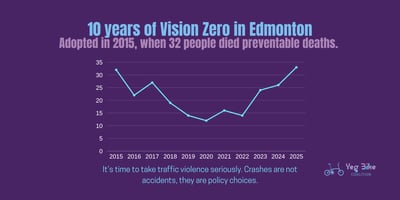
Edmonton has committed to Vision Zero: eliminating traffic deaths and serious injuries by 2032. Unfortunately, we're moving in the wrong direction. According to the Edmonton Police Service's 2025 Annual Report, 32 people died in traffic collisions in 2025, up from 26 in 2024.
Safer design is essential, but so is enforcement. When drivers can repeatedly break traffic laws without consequences, they have little reason to change their behaviour. Edmonton has already demonstrated what happens when enforcement is weakened. Following provincial restrictions on photo radar, the City's traffic safety report documented a 10.8% increase in vehicles speeding at monitored locations in 2025. The number travelling 20–29 km/h over the limit increased by a staggering 87.3% compared with 2024.
The international evidence reinforces the importance of enforcement. A Cochrane review of speed-camera studies found reductions of 11–44% in fatal and serious-injury crashes near camera sites. A 2024 Swedish study, examining 20 years of data, found that coordinated speed-camera enforcement reduced fatalities by an estimated 38.6% on the roads studied. Sweden is also among Europe's safest countries, although its success reflects a combination of street design, enforcement, vehicle safety, and other policies.
Parking enforcement is part of this same approach. Drivers blocking sidewalks, crossings, and bike lanes create real dangers for other road users. Our proposed $5 million increase would support proactive enforcement that prevents dangerous violations, rather than simply responding after someone has been put at risk.
The goal isn't more tickets. It's fewer dangerous violations, fewer injuries, and fewer deaths.
Can bike lanes actually reduce congestion?
It might seem counterintuitive that giving road space to bicycles could improve driving conditions. However, congestion isn't just about how much space we give cars. It's also about how many cars need to use that space.
Every trip someone makes without a car is one less vehicle competing for road space. Whether someone cycles, walks, or takes transit, they can reduce demand on the roads that other people need to drive on.
Research shows that adding protected bike lanes doesn't necessarily make driving slower, either. The New York City Department of Transportation found that average driving times on Eighth Avenue improved by 14% after a street redesign that included protected bike lanes and changes to turning movements.
A more recent study of Paris found that major changes to road space, including a substantial expansion of cycling infrastructure, did not produce a comparable citywide increase in congestion. Results differed between neighbourhoods, and driving speeds fell, but travel patterns also changed as people used alternatives.
That doesn't mean every bike lane improves traffic. Some projects can increase driving times on particular streets, especially when road space is reallocated. The City of Toronto's Bloor Street evaluation documented such increases, although signal timing changes reduced them.
The important distinction is between moving more cars and moving more people. A transportation network with safe, practical alternatives can help Edmonton accommodate more trips without requiring everyone to drive.
The best way to make room for people who need to drive is to give more people the option not to.
Car dependence also costs taxpayers money
Cars need space. Roads, intersections, parking, bridges, and other supporting infrastructure are expensive to build, operate, maintain, and eventually replace.
Car dependence and suburban sprawl also reinforce each other. When driving is the only practical way to get around, development can spread farther apart. That means longer roads, pipes, and utility networks serving fewer people per kilometre. The Canadian Infrastructure Council and the International Institute for Sustainable Development have both examined how these development patterns increase long-term public costs.
Edmonton has studied this problem. In 2016, the City's financial analysis projected that developing three suburban growth areas—Decoteau, Horse Hill, and Riverview—would require $10.6 billion in public infrastructure costs over 50 years, while generating only $9.2 billion in revenue. That's a projected $1.4 billion shortfall, which other Edmonton taxpayers could ultimately have to cover. These are historical projections, not current costs, but they show why the long-term cost of growth deserves attention. The findings were explained by Andrew Knack and reported by Global News.
There's also the cost of driving into Edmonton from surrounding municipalities. The City's 2024 Fiscal Gap Analysis estimated that 32% of personal vehicle kilometres travelled on Edmonton's roads came from regional residents, while Edmonton's road network is largely supported by the City's own taxpayers.
Reducing car dependence doesn't eliminate road spending, and bike lanes alone won't solve Edmonton's financial challenges. However, providing practical alternatives to driving, alongside housing and services closer together, can reduce the need for costly road expansion.
Better transportation choices can save households money today while helping Edmonton manage infrastructure costs tomorrow.
Transportation choices make life more affordable
Car ownership is expensive. Fuel is only part of the cost.
There's also insurance, maintenance, repairs, depreciation, financing, parking, and registration. The Canadian Automobile Association's Driving Costs Calculator helps illustrate how these expenses add up.
For many households, the biggest savings wouldn't come from driving a little less. They'd come from being able to avoid purchasing a second vehicle, or perhaps owning no car at all.
That isn't realistic for every Edmontonian today. Our transportation system often makes car ownership a necessity.
Better cycling infrastructure, reliable transit, and accessible sidewalks can change that. They can give families the freedom to choose the most practical and affordable way to make each trip.
A city where people have to own cars is a city where people have to pay for cars.
Making other options practical is an affordability policy. Cycling isn't practical for every trip or every person. Frequent, reliable transit allows people to travel longer distances without a car, while safe sidewalks and crossings make transit accessible. Together, these investments help people reach jobs, schools, businesses, and services. They also make it easier for households to own fewer vehicles, reducing costs and the number of cars competing for road space.
Better streets can be good for business
Businesses need customers. That doesn't necessarily mean they need every customer to arrive by car.
In 2016, Toronto replaced 136 on-street parking spaces with protected bike lanes along part of Bloor Street, a busy commercial corridor. A study published in the Journal of the American Planning Association found no negative economic impact from the bike lanes. The number of customers and their monthly spending both increased during the pilot.
The City of Toronto's own evaluation also found that people arriving on foot or by bicycle spent more per month at local businesses than people arriving by car or transit.
This isn't an isolated finding. A review of 23 North American studies found that walking and cycling improvements generally had positive or no significant economic impacts on nearby retail and food-service businesses.
There are exceptions. Businesses that rely heavily on vehicle access may face different impacts, and changes to parking or loading areas require careful planning.
However, accessible sidewalks, safe cycling routes, and reliable transit give businesses more ways to reach customers. They also help employees get to work, particularly those who don't have access to a vehicle.
A business doesn't benefit from a parking space. It benefits from customers who can reach its doors.
Edmonton should design commercial streets around access for everyone, including people making deliveries, customers with disabilities, people arriving by car, and people walking, cycling, or taking transit.
A fair city works for people who cannot drive
Not every Edmontonian can drive, and not everyone can afford to. Children, people with disabilities, seniors, and households without access to a vehicle all need safe, reliable transportation.
Disability advocate Anna Zivarts, author of When Driving Is Not an Option, estimates that roughly 25–30% of Americans don't drive. Canadian research from the Institute for Research on Public Policy suggests that 20–40% of people in a typical community cannot, should not, or prefer not to drive for most trips.
When we build a city where driving is practically mandatory, we're excluding a substantial part of the population.
Winter makes this especially clear. Snow and ice can turn an otherwise accessible sidewalk into an impassable barrier. Statistics Canada found that 36% of Canadians with disabilities aged 15 and older experienced barriers related to snow- or ice-covered sidewalks in 2022.
Edmonton has its own problems. During the 2024–2025 winter, the City received 12,400 complaints about snowy and icy sidewalks. Residents of Wîhkwêntôwin specifically identified poor sidewalk snow clearing during the City's neighbourhood renewal engagement.
This is another reason protected, well-maintained bike lanes are valuable to more than cyclists. When sidewalks are covered in snow or ice, cleared on-street bike lanes can provide a more usable surface for people walking, running, pushing strollers, or using mobility devices.
This isn't just anecdotal. The City's 2019 Bike Plan engagement report (page 19) explicitly recognized that people with limited mobility sometimes use protected bike lanes in winter because they are cleared more consistently than sidewalks.
That doesn't mean bike lanes should replace accessible sidewalks, or that mixing users with different needs is always safe. It means that properly maintained, protected infrastructure offers value beyond its original purpose, while highlighting the need to maintain the entire transportation network.
Winter cycling itself is growing. City bicycle-counter data reported by Councillor Michael Janz showed a 43% increase in cycling traffic during the colder months, October through March, between 2022 and 2024. These are recorded bicycle passages, not a count of individual cyclists, but they demonstrate growing use of the network outside summer.
We support strengthening Edmonton's proposed Well-Maintained City package because accessibility must extend beyond bike lanes. Sidewalks, curb ramps, crossings, and transit stops all need dependable winter maintenance.
A well-maintained city isn't one where every road has been cleared. It's one where people can complete their journeys safely, regardless of how they travel.
More people would cycle if they had safe places to ride
You may have heard that only about 2% of Edmonton trips are made by bicycle. That figure is based on the City's 2015 travel survey, which measured how people travelled on a typical weekday.
However, the same survey found that 59% of Edmonton households owned at least one adult bicycle.
That's a much larger group than daily cycling statistics suggest. Of course, owning a bicycle doesn't mean someone uses it regularly. The question is what prevents more people from riding.
A 2020 Canadian Automobile Association survey found that 31% of Canadians said they would cycle more if infrastructure improved. That's a national survey of people's stated intentions, not an Edmonton ridership forecast, but it identifies an important barrier.
Commuting statistics also miss much of how Edmontonians actually travel. The City's 2015 Household Travel Survey found that only 57% of weekday trips were made by people driving. Another 20% were made by car passengers, while approximately 21% were made by walking, cycling, or transit.
These figures count trips, not individual people, but they demonstrate an important point: far more Edmontonians use our transportation network without driving than commuting statistics alone suggest.
Many Edmontonians have bicycles sitting in their garages. They might enjoy riding in the river valley but not feel safe cycling to work, school, or the grocery store. Parents may be comfortable riding on a protected route but unwilling to send their children into traffic.
Today's cycling numbers tell us how people travel with the infrastructure we have, not how many would cycle with better options.
What we're asking Council to fund
Safer streets, less pressure on roads, more affordable households, stronger businesses, and better access for people who cannot drive are all benefits Edmonton can pursue through its transportation budget.
For Edmonton's 2027–2030 budget, YEG Bike Coalition is asking for:
- $100 million specifically for high-quality bike lanes, not general active transportation projects, to build a safe, connected network.
- $5 million more for parking enforcement, focused on preventing dangerous violations and improving compliance.
- Funding for Safe Mobility and improvements to Well-Maintained City, so streets are safer and infrastructure remains accessible year-round.
- Better transit and sidewalk investments, including more reliable service, safer crossings, and improved connections.
Our requests aren't about ignoring people who drive. They're about making investments that deliver the greatest public benefit, including when that means giving people better alternatives to driving.
There will be trade-offs. Some projects may affect parking or traffic flow, and not every investment will benefit every person equally. Those impacts deserve fair consideration.
However, evaluating transportation spending only by its effect on driving misses the benefits that safer, more affordable choices can provide to the entire city.
For more detail about the funding requests, project delivery, and the City's existing commitments, read our original 2027–2030 budget analysis.
Tell City Council what you want from this budget
City Council is scheduled to deliberate on the 2027–2030 budget from December 3 to 18, 2026. Councillors can change the proposed budget before approving it.
If you want to share your views on these investments, now is the time.
Email your councillor and Mayor Andrew Knack.
You can find your city councillor and their contact information here, and reach the Mayor at andrew.knack@edmonton.ca.
You don't need to be an expert or write a long submission. Explain how transportation choices affect your household, neighbourhood, or business. Tell Council which investments you support, which concerns you have, and what results you expect from public spending.
You might mention a road that feels dangerous, a sidewalk that's difficult to use in winter, a bus route that doesn't meet your needs, or a trip you'd like to make without driving.
Edmonton has already committed to safer streets, better transportation choices, and responsible growth. The budget is an opportunity to put money behind those commitments.
You don't have to ride a bike to want a safer, healthier, more affordable Edmonton.