
The YEG Bike Coalition strongly opposes the Province of Alberta’s proposed interference with the...
For one week, we're going to show you. August 31 to September 6, 2026.
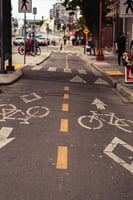
Bike lanes are often described as something that takes space away from traffic.
But people on bikes are one type of traffic.
If separated infrastructure disappears, the people using it do not disappear with it. They move into the roadway. Drivers share the lane with them. Passing takes more space. Every cyclist stops individually at stop signs. Families, commuters, students and recreational riders are suddenly navigating the same traffic lanes as cars, trucks and buses.
Cyclists areare legally allowed to be in the road. Alberta law does not require cyclists to use a bike lane when one is available. In Edmonton, cyclists are allowed on city roads as well as bike lanes and shared pathways.
So during the first week of September, we are inviting Edmontonians to participate in Week Without Bike Lanes.
For one week, leave the bike lane behind.
Keep riding your bike. Take the same trips you normally take. You can absolutely travel along streets that have bike infrastructure—but, where you can do so safely and legally, use the regular roadway instead.
And follow the rules of the road carefully.
This is not about blocking traffic. It is not about riding dangerously or trying to make drivers angry.
It is about answering a simple question:
What would Edmonton actually look like if we didn't have bike lanes?
If you don't feel safe taking the lane, you can still participate by adding a sign to your bike!
Why Are We Doing This?
Alberta's government is preparing legislation that could give the Province greater power over municipal bike lanes. At the same time, Edmonton City Administration is recommending changes that would remove numerous planned routes from the Active Transportation Network Expansion program if building them requires reallocating parking or vehicle travel lanes.
A lot of the political conversation treats bike lanes as though they create cyclists.
They don't.
Bike lanes create separation.
Without that separation, someone riding to work is still going to work. Someone biking to school is still going to school. Someone who cannot afford a car still needs to get around. Someone riding for exercise or recreation still has the legal right to use Edmonton's roads.
The difference is that now everyone occupies the same space.
Edmonton itself tells road users that cyclists have the same rights and responsibilities as other vehicles and are permitted on city roads. Drivers passing someone on a bicycle must leave at least one metre where the speed limit is 60 km/h or less, and 1.5 metres above 60 km/h. If there isn't enough room to pass safely, drivers have to wait.
That's part of what bike lanes accomplish for drivers, too: they give people travelling at very different speeds their own predictable spaces.
Week Without Bike Lanes will make that visible.
The Point Is to Follow the Law
For this demonstration to work, we need to do it properly.
No Idaho stops. No rolling through stop signs. No riding two abreast. No hopping onto the sidewalk when traffic gets uncomfortable. No unpredictable weaving between parked cars.
And no deliberately crawling along to create congestion.
Ride normally. Ride predictably. Ride safely.
The inconvenience—if there is any—should come entirely from what happens when people on bikes use ordinary streets exactly as Alberta law expects them to.
The Rules We Will Follow
Use the roadway.
Bicycles are vehicles, and cyclists are allowed to use Edmonton roads. They are not required to use a bike lane simply because one exists.
During Week Without Bike Lanes, we are asking participants to avoid the infrastructure that normally separates bikes from general traffic wherever they can safely do so.
That includes protected bike lanes, painted bike lanes and shared pathways.
The point isn't to avoid every street identified as a “bike route.” A local street bikeway where bicycles and motor vehicles already share the roadway fits perfectly with what we're demonstrating.
The goal is to experience Edmonton for a week without relying on the separated spaces that normally keep us out of motor traffic.
But this is not a purity test.
Your Safety Comes First
Only you can decide what feels safe enough for you to ride.
If avoiding a bike lane or shared pathway would put you somewhere you do not feel safe, use the bike infrastructure.
There are shared pathways along some large, fast and busy roads precisely because mixing bicycles into that traffic would be an unreasonable choice for many riders. We are absolutely not asking people to leave paths along corridors such as Groat Road, 91 Street or Terwillegar Drive and put themselves into high-speed traffic just to prove a point.
-
Use your judgement.
-
Use the path.
-
Get off and walk.
-
Skip the trip.
-
Whatever you need to do.
The most important outcome of every ride is that you get where you're going safely.
If you don't feel comfortable taking the lane - then don't! You can still participate by adding a sign to your bike, bag, or jacket. I'
Ride as far right as is practicable—not as far right as physically possible.
Alberta's rules require cyclists to ride as near as practicable to the right curb or edge of the roadway, except when making a left turn.
The key word is practicable.
It does not mean hugging the gutter.
A safe and practicable riding position needs to account for parked-car doors, potholes, drains, debris, visibility, intersections and the space required for other vehicles to pass safely.
The City tells cyclists to ride far enough from the curb to avoid obstacles, remain visible and maintain a straight line instead of weaving in and out of parked vehicles. It also explicitly tells drivers that someone cycling may be riding in the middle of the lane to avoid hazards near the curb.
On many Edmonton streets, the safest practicable position may therefore be near the centre of the travel lane.
That position keeps you out of the door zone, keeps you visible and makes it clear when there isn't enough space for a driver to squeeze illegally past within the same lane.
Take the space you need.
Hold a predictable line.
Do not weave into empty parking spaces and then back into traffic.
Do not ride in the gutter simply to make an unsafe pass possible.
When there isn't enough room to pass you safely, the correct response is for the driver to wait and make a proper passing manoeuvre when space becomes available. Edmonton specifically tells drivers to wait until it is safe and permits them to cross a solid yellow line when safe in order to provide the required passing distance.
Come to a complete stop. Every time.
No Idaho stops.
No rolling stops.
When a stop is required, bring your bicycle to zero velocity.
Where a stop line is painted, stop before crossing it. Alberta's official driver guidance describes the required position as stopping before the stop line or crosswalk.
For this campaign, make it unmistakable:
Stop completely with your bicycle behind the stop line. Look. Yield as required. Then proceed.
If visibility is poor from that position, complete the required stop first and then carefully move forward until you can see.
And if you are riding as a group, everyone stops.
Five cyclists approaching a stop sign means five separate complete stops. The rider in front stopping does not satisfy anyone else's obligation.
Follow the law exactly.
It may take longer.
That's part of what streets without separated cycling infrastructure look like.
Pedestrians Come First
We want to be especially clear about this one.
Yield to pedestrians. Every time.
Edmonton's Public Spaces Bylaw requires people cycling to yield the right of way to pedestrians and slower-moving people. When overtaking someone, cyclists must give an audible warning with reasonable notice and use reasonable care.
That means slowing down.
That means stopping when required.
That means giving people plenty of room.
If you do use a shared pathway because the roadway is unsafe, pedestrians and slower users get priority. Ring your bell before passing, give them time to react, slow down and pass carefully on the left. The City's own guidance says the same thing.
We are all people trying to move through our city safely outside the protection of a motor vehicle. A campaign for safer cycling cannot come at the expense of someone walking, using a wheelchair, pushing a stroller or otherwise moving more slowly than us.
Respect pedestrians. Give them space. Make them feel safe around you.
Obey traffic signals.
A bicycle being ridden on the roadway is subject to traffic-control devices.
Red means stop. A stop sign means stop.
A one-way street is still a one-way street.
Do not use the campaign as a reason to make a manoeuvre that would otherwise be illegal.
This is especially important around contraflow bike lanes. Some bicycle infrastructure permits bikes to travel in a direction general traffic cannot. If avoiding that bike lane would require you to ride the wrong way on a one-way street, don't do it. Use another street, travel in the legal direction or use the bike facility.
The demonstration only works if we're following the law.
Ride single file.
Alberta requires cyclists travelling together in the same direction and lane to ride directly in line with one another except when overtaking.
So ride single file.
If you are with friends, family or another cyclist you catch up with along the way, form a line.
And remember: when that line reaches a stop sign, every cyclist stops individually.
Signal what you're doing.
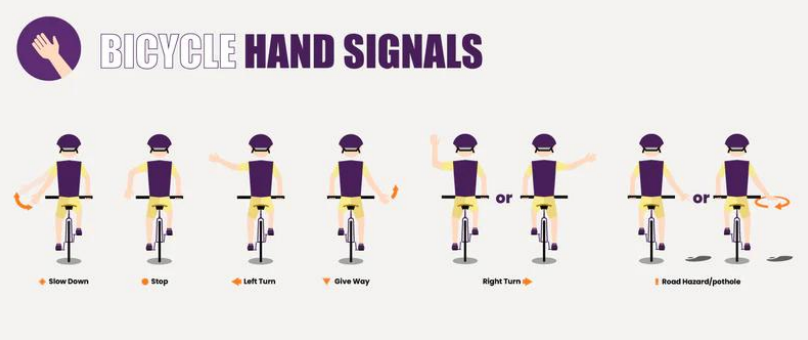
Alberta law requires road users to signal turns and stops with enough warning for others to understand their intentions. For a bicycle, the prescribed hand signals are: left arm straight out for a left turn; left arm bent upward for a right turn; and left arm bent downward when stopping or slowing. Shoulder-check first, signal clearly, then make your movement when it is safe.
Keep Your Hands on the Bike and Your Attention on the Road
Do not hold a phone, camera, protest sign or anything else while riding.
Alberta requires cyclists to keep both hands on the handlebars except when signalling, and distracted cycling can result in a fine.
Set your camera before you start. Mount your phone if you need it for navigation.
Mount any campaign sign securely to your bike, bag, trailer or cargo box.
Your attention should be on the road and the people around you.
Ride at a normal, safe pace.
Do not deliberately crawl along simply to delay people. Ride at the pace you would normally ride for the conditions.
The point is not to manufacture congestion. The point is to let the normal consequences of mixing bicycles and motor vehicles become visible.
Sometimes that will mean a driver safely changes lanes and barely notices you.
Sometimes it will mean they need to wait.
Both are normal parts of sharing a road.
Make Sure Your Bike Is Ready.
Before participating, check your brakes, tires, steering, drivetrain and bell. If you are not sure how to do this, book an appointment with Bike Edmonton.
Alberta requires bicycles to have a functioning brake and a bell or horn. At night, bicycles must have a non-flashing front headlamp, a non-flashing red rear lamp and a rear red reflector.
A quick equipment check before the week begins can prevent a mechanical problem from becoming a safety problem in traffic.
Taking the Lane Safely
Some riders are understandably uncomfortable moving away from the curb.
That's one reason protected infrastructure is so valuable.
The safest place to ride is not always the place that feels least disruptive to drivers. Riding too close to the curb can put you beside drains, potholes and debris. Riding beside parked vehicles puts you in the door zone. Moving repeatedly in and out of parking gaps makes you less predictable.
Instead, choose a safe, predictable line and hold it.
When the safe and practicable position is farther into the lane, take that space confidently. Shoulder-check before moving left. Signal when appropriate. Avoid sudden movements. Do not move back toward the curb until there is a safe reason to do so.
Edmonton's own guidance tells cyclists to ride far enough from the curb to avoid obstacles and remain visible, and tells drivers that people on bikes may be in the middle of a traffic lane to avoid hazards.
Drivers still have an obligation to pass safely. In Edmonton that means leaving at least one metre at ordinary city speeds. The City advises drivers that they may cross a solid yellow line when it is safe to do so to provide the required passing distance—and, when it isn't safe to pass, to wait.
You don't owe anyone an unsafe squeeze past.
You do owe everyone around you predictable, lawful behaviour.
What Drivers Should Expect
If you drive during Week Without Bike Lanes, you may encounter more bicycles in regular traffic lanes.
Nothing has gone wrong.
That is what streets without separated cycling infrastructure look like.
Give riders space. Don't honk because someone is lawfully occupying the roadway. Don't attempt to squeeze past within the same lane when there isn't enough room. Wait until you have adequate sight distance and space, then make a normal safe pass.
You might have to wait behind someone riding at 20 km/h or less.
You might encounter several cyclists approaching a stop sign and watch each of them stop before proceeding.
You might discover that the protected lane beside you was doing more for your commute than you realized.
That's the point.
We are encouraging cyclists to use front and rear facing cameras and to report any illegal or unsafe behaviour to the police. As a driver, you have a legal responsibility to follow the law, and to avoid doing anything that can result in a collision.
Learn With Us Before the Week Begins
If riding in traffic is unfamiliar, you do not need to figure it out alone.
At Critical Mass on Friday, August 28, we'll include training on safely riding in traffic: lane positioning, taking the lane when necessary, shoulder checks, hand signals, stopping, riding single file and communicating with other road users.
Come practise in a supportive group before Week Without Bike Lanes begins.
And if you aren't comfortable riding a particular road during the campaign, don't. Choose another route or participate in another way. No demonstration is worth putting yourself in a situation you believe is unsafe.
A Few More Things We Recommend
Week Without Bike Lanes should be visible, predictable and safe. A few extra precautions can help.
Use front and rear cameras if you have them
A front camera is useful. A rear camera is even better. Using both gives you a record of what happened before, during and after an interaction. We encourage you to report any illegal or unsafe behaviour to the police.
We hope everyone has an uneventful week. But if a driver makes an illegal or dangerously close pass, threatens or intimidates you, deliberately uses their vehicle to bully you, or otherwise behaves dangerously or antisocially, save the footage.
Share relevant clips with us. These interactions can help document why separating people on bikes from motor vehicles is necessary in the first place.
If something serious happens, preserve the original video rather than only saving a social-media copy. Most importantly, do not chase, confront or escalate with a driver to get better footage. Your camera can record the behaviour; your job is to get home safely.
Use lights—even during the day
Run a white front light and red rear light whenever possible. They can make you easier to notice even when the sun is up.
Lights are legally required when cycling at night, along with a rear red reflector. Edmonton also requires bicycles to have a bell or horn and working brakes.
Wear a helmet
For adults riding conventional bicycles, Alberta does not generally require a helmet, but we recommend wearing one anyway. Riders under 18 are legally required to wear an approved helmet.
This campaign is intended to demonstrate the consequences of removing separated infrastructure—not to increase anyone's personal risk unnecessarily.
Tell people what you're doing
A small sign on your bike, backpack, cargo box or trailer can turn an irritated driver wondering “Why is that cyclist here?” into someone who understands the point of the demonstration.
Keep it short enough to read through a windshield.
Some ideas:
- THIS IS WHAT NO BIKE LANES LOOKS LIKE
- BIKES ARE TRAFFIC TOO
- BIKE LANES REDUCE TRAFFIC CONGESTION
- NO BIKE LANE = SHARE THE ROAD
- SAFE BIKE LANES HELP EVERYONE
Our favourite might be the simplest:
BIKE LANES KEEP TRAFFIC MOVING
Because that's one of the things we want people to notice during the week.
When people on bikes have their own space, drivers generally don't have to change lanes to pass them, wait behind them at narrow sections, or interact with them at every stop.
Take that space away and the bikes don't disappear.
We become traffic.
For One Week, Show What the Alternative Looks Like
We build bike lanes because mixing large, fast vehicles with people riding bicycles is an unnecessary conflict.
Separated infrastructure gives someone riding a bike a safer place to travel. It gives families and less-confident riders routes they may actually feel comfortable using.
But it also gives drivers something.
It gets bikes out of the traffic lane.
So, for one week, let's imagine Edmonton without bike lanes.
Keep riding.
Follow the law.
Be predictable.
Be visible.
Be safe.
And let Edmonton see what sharing the road really looks like when there is nowhere else for us to go.
Week Without Bike Lanes — first week of September.