

Assessing Edmonton’s Cycling Infrastructure: Insights from Can-BICS and What’s Needed for a Robust...
Edmonton has big plans for its transportation system. The City committed to eliminating traffic deaths, building a connected bike network, supporting more housing in existing neighbourhoods, and giving people more ways to get around.
Our budgets, policies, and actions haven't kept pace with those commitments.
Important projects are delayed or cancelled. Streets are rebuilt without fixing known safety problems. Cycling infrastructure is built without adequate consideration for maintenance, safety, or connectivity. Now, Council is considering redirecting money intended for neighbourhood renewal toward arterial roads.
These problems didn't appear overnight. They reflect decades of decisions that have prioritized vehicle movement and parking over safety, accessibility, and more affordable transportation choices.
As City Council prepares Edmonton's 2027–2030 budget, YEG Bike Coalition wants more than another round of promises. We want the funding, better design standards, and organizational accountability needed to deliver real improvements.
We're not asking Council to reinvent Edmonton's transportation strategy. We're asking Council to fund it, follow it, and stop making decisions that undermine it.
TL;DR — What we want in the 2027–2030 budget
- 2% of Capital Transportation Funding dedicated to cycling
Build a connected cycling network, fix dangerous intersections, complete missing links, and expand safe cycling infrastructure into more neighbourhoods.
- At least $5 million for parking enforcement
Fund proactive, around-the-clock enforcement, with rapid responses to vehicles blocking sidewalks, bike lanes, crossings, and accessible routes.
- $25 million for Snow and Ice Control (SNIC)
Keep walking, cycling, and transit connections safe and accessible throughout winter, with reliable clearing, better enforcement, and a connected winter cycling network.
- Fully fund Safe Mobility and Vision Zero
Fund the expanded Safe Mobility Strategy, prioritize physical safety improvements, and demand meaningful accountability for the City's failure to reduce traffic deaths and serious injuries.
- Protect Building Great Neighbourhoods funding
Keep neighbourhood renewal funding in neighbourhoods, adequately fund major projects, and ensure reconstruction delivers safe, accessible streets.
- Fund arterial renewal separately
Maintain and improve existing arterial roads without raiding neighbourhood renewal funds. Any additional spending should be transparent, justified, and focused on long-term public benefits.
Our three specific funding requests total $130 million over four years, in addition to fully funding Safe Mobility and protecting existing renewal programs.
Funding is only part of the solution. Edmonton also needs better design standards, stronger enforcement, coordinated construction, and leadership willing to acknowledge failures and change course. We want to see the City be more ambitious in their budget, tackling the decades of bad decision-making that have caused the problems we are facing today.
We cannot solve decades of poor transportation decisions by continuing to make the same mistakes. The 2027–2030 budget is an opportunity for Council to demonstrate that its commitments to safety, accessibility, and transportation choice are more than words.
Take Action
The 2027–2030 budget will shape Edmonton for the next four years, and we need your help making sure safe streets and transportation choices remain priorities.
The Edmonton Chamber of Commerce is organizing businesses to speak at Council in support of its Back on Track budget proposal, which calls for spending restraint and scaling back parts of neighbourhood renewal.
We need Edmontonians who support safe streets, bike lanes, Vision Zero, and better winter maintenance to be heard too.
Public speaker registration is expected to open Monday, November 2. Speaking opportunities may be limited, so register early!
Here's what you can do:
- Register to speak at City Council starting Monday, November 2. Look for the November 24 budget session and confirm the date and registration instructions on the City's website. There are limited spots available to speak, and you can bet that people who don't want bike lanes funded will be speaking. Register now.
- Tell Council what you want funded. You don't need to be an expert. Share how safer streets, cycling infrastructure, winter maintenance, or traffic safety affect you and your community. Personal stories are powerful.
- Share this post. Encourage friends, neighbours, and other supporters to register and speak. A few minutes of your time can help shape four years of City spending.
Important dates
- Monday, November 2: Proposed budget released; speaker registration expected to open.
- Monday, November 23: Budget presentations to Council.
- Tuesday, November 24: Expected opportunity for public speakers, subject to the City's finalized schedule.
- December: Council budget deliberations and decisions.
Safe streets don't happen by accident. They happen when Edmontonians speak up and Council chooses to invest in them.
Let's make sure Council hears from the people who want Edmonton to move forward, not backward.
1. 2% of Capital Transportation Funding dedicated to cycling
In the 2023–2026 budget, Council approved $100 million for Active Transportation Network Expansion. This was a major investment in giving Edmontonians more ways to get around safely.
There have been some genuinely good results. The protected bike lanes on 113 Street and 100 Street, the improvements along 132 Avenue, and the work underway on Victoria Park Road show what Edmonton can accomplish when safe cycling infrastructure is a priority.
These projects deserve recognition. The City has demonstrated that it can build good cycling infrastructure. We want that quality to become the standard, not the exception.
Unfortunately, much of ATNE has delivered something quite different.
The City reports that 35 kilometres of active transportation connections were built during 2024 and 2025, with another 33 kilometres planned for 2026 and beyond. But those kilometres include wide sidewalks, shared-use pathways, and streets where cyclists remain mixed with motor vehicles.
In September, Taproot Edmonton reported our assessment that only about five kilometres of the ATNE infrastructure built at that point consisted of protected bike lanes.
That's a dismal outcome for a project widely called "$100 million for bike lanes"; an investment intended to accelerate the Bike Plan. It was never that however, and we should not judge the success of thi program about what people called it online.
The Active Transportation Network Expansion (ATNE) project was always about Active Transportation (AT) broadly, not cycling specifically. That includes people walking, using mobility devices like wheelchairs, and micro-mobility devices like scooters.
For other active transportation users, ATNE has delivered useful connections, but the safety of some of this infrastructure is questionable. Much of the program has relied on shared-use pathways (SUPs), effectively wide sidewalks where pedestrians, cyclists and people using mobility devices share the same space.
Council has directed Administration to reduce the ordinary sidewalk-cycling fine to $25, a change we've advocated for. But the difference in how the City regulates and enforces use of pedestrian space deserves much closer scrutiny.
A shared-use sign doesn't make an unsafe crossing safe. And a parked car doesn't become less of an obstruction because its driver faces a smaller fine.
This outcome was built into the program from the beginning. The City's original $100 million capital profile explicitly prioritized easier connections for accelerated construction, leaving more difficult routes requiring changes to parking or driving lanes for later, potentially as late as 2030.
As Councillor Ashley Salvador told Taproot Edmonton, Administration began with the "low-hanging fruit," including widening sidewalks into shared-use pathways.
That decision has consequences. Edmonton built many of the easier connections while leaving some of the most important—and politically contentious—protected bike lanes until later. Now those projects face delays, cancellation, and potential provincial intervention.
The City had the funding and the opportunity to build a safer cycling network. It chose an implementation sequence that left some of the most important work unfinished and vulnerable to political interference.
Here's the contradiction: Edmonton prohibits cycling on ordinary sidewalks, partly because drivers don't expect cyclists crossing alleys, driveways and intersections. Yet the City continues to build shared-use sidewalks that recreate those same dangerous conflicts. Consider how the City treats these offences: riding a bicycle on an ordinary sidewalk carries up to $500 in fines, while parking a car on that same sidewalk carries a fine of just $50. A driver can completely block pedestrian access, forcing people into unsafe situations or completely blocking a person in a wheelchair, for one-tenth the fine of a cyclist taking the safest option the city has provided them.
We should judge ATNE by what it actually delivered, not simply by the number of kilometres Administration reports.
We had the opportunity. We needed to build.
In a recent video about cycling infrastructure in Lyon and Montreal, Canadian urbanism channel Oh The Urbanity! examines how political changes can derail ambitious transportation plans.
Lyon managed to build approximately 100 kilometres of mostly high-quality bike lanes in just a few years. Other projects are now facing cancellation or delay following a change in political leadership.
The video ends with a warning: "So build it while you can."
Edmonton had that opportunity. Council approved $100 million, adopted a Bike Plan, and directed Administration to expand the network.
There were successes, but too much of that opportunity was spent on infrastructure that didn't adequately advance the City's cycling goals.
Now, with provincial intervention threatening existing bike lanes and uncertainty surrounding future funding, the consequences of those missed opportunities are becoming clearer.
We cannot afford another four years of counting wide sidewalks as progress toward a safe, connected cycling network.
What about the next four years?
We understand Administration is preparing an approximately $30 million proposal for active transportation improvements through the updated Active Transportation Implementation Guide (ATIG), relying heavily on projects delivered through Building Great Neighbourhoods.
If that is the full extent of the proposed investment, it would be 70% less than the previous $100 million ATNE allocation, even before accounting for inflation.
And that money wouldn't be dedicated to cycling infrastructure. It would need to address a broader range of active transportation improvements.
There's another problem: Council has been considering redirecting neighbourhood renewal funding toward arterial roads. That could reduce the very funding Administration is counting on to deliver these projects.
A smaller active transportation program dependent on another program facing funding cuts is not a credible plan to complete the Bike Plan.
Edmonton needs a dedicated construction budget, supported by ATIG, neighbourhood renewal, and Safe Mobility working together.
We want Council to approve another $100 million in the 2027–2030 capital budget, dedicated specifically to bike lanes and their essential connections.
We acknowledge the current political issues. Bikelash is real, drivers are more aggressive than ever, and the Province is letting people that don't live in Edmonton decide what transportation in the city should look like. We want to see council stand up for municipal autonomy, deliver the transportation commitments Council has made, and stand up for the safety of Edmontonians.
From the Safe Mobility Strategy (page 18):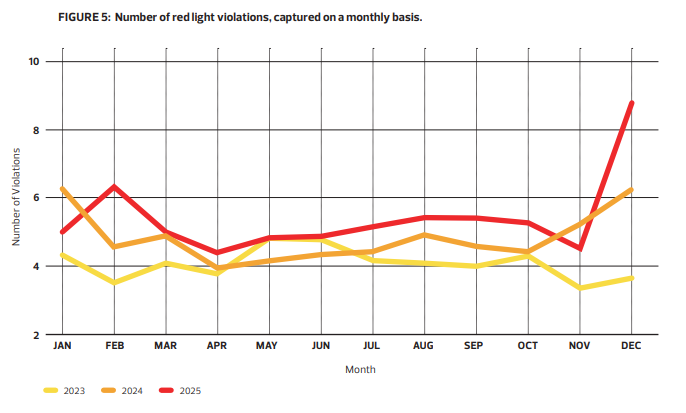
The investment should focus on four outcomes:
- Safety
Build genuinely safe, All Ages and Abilities cycling infrastructure, with protected intersections and crossings. Stop using painted lanes, poorly designed shared pathways, and other substandard facilities as cheap substitutes. - Connectivity
Close gaps, fix dangerous intersections, and expand outward from existing routes to create a connected citywide network. - Meaningful engagement
Work directly with people who use the network, including people who would cycle if they felt safe. Their needs and experiences must shape what gets built. - Year-round usability
Design infrastructure for winter conditions and ensure that routes can be maintained and kept clear of illegally parked vehicles.
Some of this funding should also replace existing substandard infrastructure. Painted bike lanes, shared-use pathways with dangerous crossings, and designs that put cyclists between moving vehicles and parked cars should be replaced with properly protected facilities.
Our priority isn't simply building more kilometres. It's building a network that people can actually use, safely, comfortably, and year-round.
A protected bike lane that ends at a dangerous intersection isn't a complete route. Neither is a comfortable pathway that forces people across busy roads without safe crossings.
Walking, accessibility, and other active transportation improvements also deserve substantial investment, but they should have separate funding. We want to know that $100 million for cycling actually delivers $100 million in cycling infrastructure.
Related advocacy priorities
Fix Complete Streets before building more infrastructure
Edmonton's Complete Streets Design and Construction Standards need a major overhaul. Painted bike lanes should not be accepted where separation is needed. Roadside shared-use pathways should only be considered where intersections and accesses are properly protected, or where conflicts are sufficiently rare. Protected intersections, safe crossings, and winter maintenance must be built into designs from the beginning.
We should not spend another $100 million building infrastructure that will need expensive safety upgrades later.
Build outward from what already exists
Prioritize missing links, intersections, and routes that extend the existing network. Then expand into underserved parts of Edmonton, connecting destinations along the way.
Plan for infill
Neighbourhoods adding more homes need better transportation choices. ATIG should account for population growth, planned infill, and the increased demand for walking, cycling, and transit.
Coordinate construction
ATNE, ATIG, neighbourhood renewal, Safe Mobility, utilities, and transit projects must work together. We want a publicly accessible, citywide map showing what will be built, where, when, and through which program during 2027–2030.
The City should coordinate construction so projects connect and opportunities to improve streets during reconstruction aren't missed.
Engage the people who will use the infrastructure
Affected cyclists, pedestrians, people using mobility aids, and other at-risk road users should be engaged before designs are finalized. Engagement should identify safety problems and improve projects, not simply measure opposition to changes in parking or traffic lanes.
Protect previous commitments
Previously approved and delayed routes must not quietly disappear. Administration should publish what was promised, what has been completed, what remains outstanding, and when it will be delivered.
Measure what actually gets built
Before approving another $100 million, Council should require Administration to identify exactly what that investment will deliver, including specific routes, protected intersections, annual construction targets, and the gaps it will close.
We want a publicly accessible, citywide map showing what's planned for each year from 2027–2030, along with regular updates on what has been completed, delayed, or cancelled.
The City must report protected bike lanes, upgraded cycling infrastructure, shared pathways, and pedestrian improvements separately. Counting all of these together conceals whether Edmonton is actually delivering the Bike Plan.
Council should know what $100 million will buy before approving it, and Edmontonians should be able to see whether the City delivers what it promised.
Why $100 million? Equitable investment in cycling
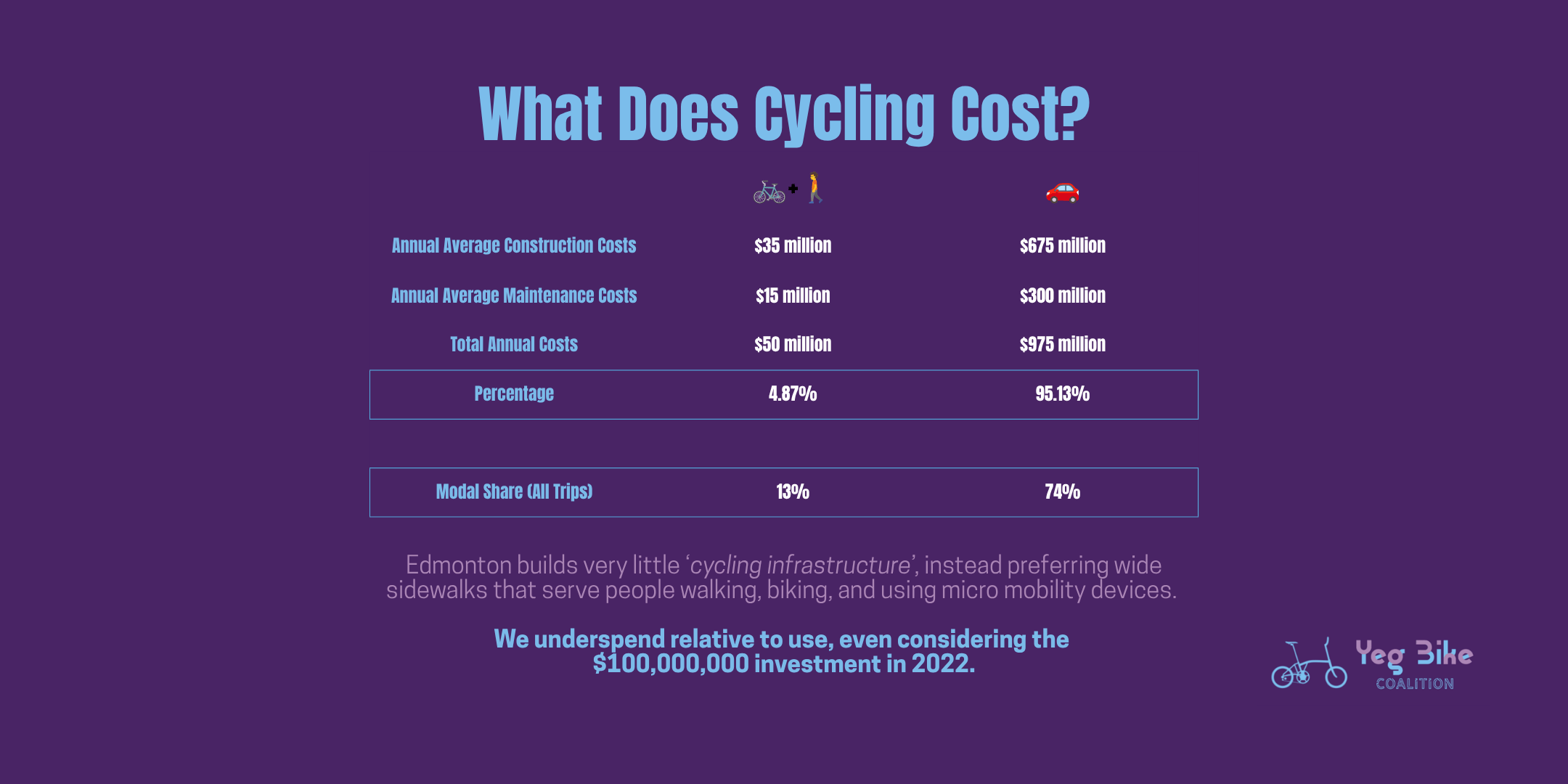
$100 million sounds like a lot, but it's remarkably little compared with Edmonton's overall transportation spending.
In the 2023–2026 budget, the City allocated approximately $5 billion to transportation capital projects. ATNE received just $100 million, or 2%.
Meanwhile, Edmonton's 2015 Household Travel Survey found that 1.7% of daily trips were made by bicycle, 10.8% on foot, 8.6% by transit, and 77.6% by private vehicle. That means that 2% of the transportation capital spending budget goes to support about 20% of commuters (cyclists, pedestrians, micro-mobility, and those with accessibility needs) and transit users who often walk to their local bus stop.
We're asking for roughly the same share of transportation capital investment as cycling's existing share of trips.
That's a reasonable minimum, not an ambitious investment in growing cycling. And because the previous ATNE budget paid for many facilities that weren't dedicated bike lanes, the amount actually invested in protected cycling infrastructure was substantially smaller.
People who bike pay taxes too. They deserve to see their taxes invested in infrastructure that serves them.
But simply matching today's cycling share isn't enough. There are three reasons we should invest more:
- Fairness: Every Edmontonian deserves safe, practical transportation options, regardless of how they travel. Transportation spending should reflect the needs of people cycling, not just those driving.
- Making up for decades of underinvestment: Edmonton has spent generations building infrastructure primarily around cars. Today's cycling numbers partly reflect a network that remains unsafe, incomplete, or unavailable to many residents.
- Saving lives: Well-designed protected bike lanes separate cyclists from motor vehicles, while protected intersections reduce dangerous conflicts. Safe cycling infrastructure is a traffic safety investment.
The City will never achieve its transportation goals while continuing to prioritize driving over everyone else.
The City itself calls this a free-rider problem. Edmontonians are subsidizing regional driving while struggling to fund safe transportation choices for the people who actually live here.
Council needs to address that inequity rather than continuing to pour money into a road network whose costs are disproportionately borne by Edmonton taxpayers.
A fair transportation budget shouldn't simply preserve inequalities created by past spending. It should help correct them.
And while 2% was allocated to ATNE, that doesn't mean the other 98% went exclusively to drivers. Transportation capital also supports transit, bridges, pedestrian infrastructure, and other shared facilities. The important comparison is that dedicated cycling investment remains a tiny portion of the overall transportation budget.
Two percent for bike lanes should be the floor, not the ceiling.
Bike lanes benefit everyone, not just cyclists
Even Edmontonians who never ride a bicycle benefit from a safe, connected cycling network.
- Safer streets: Protected cycling infrastructure and safer intersections reduce dangerous conflicts between road users.
- Less congestion: Every car trip replaced by a bike trip is one less vehicle competing for road space.
- Cleaner air and fewer emissions: Replacing car trips with cycling reduces pollution and greenhouse gas emissions.
- Lower infrastructure costs: Bicycles require less space, cause very little road wear, and can reduce pressure for expensive road and parking expansions.
- More affordable transportation: Cycling gives households another practical way to get around without the expense of owning and operating a car.
- Healthier communities: Making cycling safe and convenient supports physical activity and can reduce long-term healthcare costs.
These benefits depend on building a network people actually want to use. A disconnected collection of unsafe facilities won't encourage nearly as many people to leave their cars at home.
Bike lanes are a public investment, not a special benefit for a small group of people.
Edmonton's City Plan calls for half of all trips to be made by active transportation and transit as the city grows toward two million residents.
That is a very different transportation system from the one we have today. Getting there requires a different approach to investment, design, and delivery.
After decades of building our city around driving, dedicating 2% of transportation capital spending to bike lanes is hardly excessive.
Edmonton has shown us it can build good bike lanes. Now it needs to stop treating them as exceptions and start building a connected network of them.
A related problem: Edmonton is subsidizing regional driving
There's another important question about fairness in transportation spending: Who is paying, and who is benefiting?
Edmonton's own 2024 Fiscal Gap Analysis (pages 112-114) identifies a significant free-rider problem in our transportation network.
The City estimates that 32% of vehicle-kilometres travelled on Edmonton roads are driven by regional residents. Accommodating that traffic requires approximately 47% more road capacity, with the construction, maintenance, snow clearing, and operating costs that come with it.
Those drivers pay residential property taxes to surrounding municipalities, not Edmonton. They use our roads without directly paying for the additional costs their driving imposes on our transportation network.
The City itself calls this a free-rider problem.
Edmontonians are subsidizing regional driving while struggling to fund safe transportation options for the people who actually live here.
This is especially concerning when Council considers redirecting neighbourhood renewal funding to arterial roads, many of which serve substantial regional traffic.
Edmonton needs a fairer way to recover the costs of regional transportation. In the meantime, Council should stop treating additional road capacity as a higher priority than safe, affordable transportation choices for its own residents.
2. $5 million for effective parking enforcement
Edmonton has parking rules for good reasons. They protect visibility at intersections, keep crossings accessible, and prevent vehicles from blocking spaces intended for other road users.
Unfortunately, rules are only useful when people follow them, and the City has not provided the resources needed to enforce them effectively.
In 2025, Edmonton received approximately 82,000 parking complaints, up 45% from 2023. The City reported responding to just 68% of parking complaints within its 48-hour service standard. A standard that is already too low and demonstrates that the City is not taking Vision Zero seriously.
Anyone who regularly walks, cycles, or uses a mobility aid has likely encountered illegally parked vehicles blocking their route. Those obstructions can force people into traffic, reduce visibility, and make otherwise accessible infrastructure unusable.
That's why we want an additional $5 million in the 2027–2030 budget to strengthen parking enforcement. There is a compelling financial argument for doing so.
Administration has already estimated that an additional $1 million in annual parking enforcement funding could generate approximately $2 million in fine revenue. That's a projected return of $2 for every $1 invested, before considering the benefits of safer streets and improved accessibility. But, a budget increase of $1 million is nowhere close to enough - it fails to get them back to their already failing state of 2018.
The City has identified an investment that could pay for itself while improving public safety. Council should take advantage of it.
The funding should provide more enforcement officers, proactive patrols, faster responses to complaints, 24-hour coverage, and modern enforcement tools.
Any additional revenue beyond the costs of enforcement should be reinvested into expanding enforcement capacity or physical infrastructure that prevents illegal parking.
The objective is compliance, not ticket revenue. As drivers begin following the rules, fine revenue should fall. That's a success, not a failure.
Related advocacy priorities
Establish a Parking Enforcement Service Standard
Council has already requested work on service standards. Those standards should establish reasonable response times and measurable expectations for proactive enforcement. In particular, any parking issue that impacts safety or accessibility should require a 30-minute response, 24 hours a day, and seven days a week.
New parking issues should generally be prioritized over older submissions. Drivers often do not park illegally for long, and it is not a good use of extremely limited resources to have officers driving around closing tickets hours, or often days after the violation was reported. "30 minutes or it's free" is effectively how parking enforcement needs to operate because drivers need to know their law breaking is being taken seriously.
Prioritize risk, not just complaints
A vehicle blocking an accessible crossing or protected bike lane creates a different problem than an expired meter.
Enforcement resources should focus on the violations that create the greatest risks, with proactive patrols at known problem locations rather than relying entirely on 311 complaints.
Connect enforcement to Vision Zero
Parking enforcement must be treated as part of Edmonton's transportation safety system, not merely a service for managing parking turnover.
When illegal parking routinely goes unenforced, drivers have little reason to expect consequences. That undermines compliance and leaves dangerous conditions in place.
Edmonton's Vision Zero commitments should be reflected in how enforcement resources are deployed, how violations are prioritized, and how the City measures results. When drivers are not held accountable for breaking the law, they learn that they do not have to follow the law. Parking enforcement is an incredibly important part of achieving Vision Zero, and the City has completely ignored this important tool.
Review fines and enforcement tools
Fines should reflect the risks and harm caused by violations.
Consider this comparison: Edmonton's published fine for parking a car on a sidewalk is just $50, while unsafe bicycle operation can carry a $250 fine.
A driver can completely obstruct pedestrian access, potentially forcing someone using a wheelchair into the road, yet face a substantially smaller penalty. That is precisely backwards.
The City should review fines for dangerous parking violations, provide effective towing and removal powers, and modernize enforcement technology.
Council is already considering funding for electronic ticketing. That should be part of a broader investment in enforcement rather than a substitute for putting officers on the streets.
Measure compliance
The City should report how quickly officers respond to active safety violations, how many are resolved while the vehicle is still present, where repeat violations occur, and whether compliance improves over time.
Success is fewer dangerous parking violations and safer streets, not simply more tickets.
3. $25 million for Snow and Ice Control
Edmonton is a winter city. Our transportation system needs to work in winter - no matter how people choose to move around their city.
We can build the best cycling infrastructure in Canada, but it won't be useful for months on end if it's buried in snow, covered in ice, or blocked by snowbanks.
The same applies to sidewalks, curb ramps, crossings, and transit connections. For people using wheelchairs and other mobility devices, a poorly maintained route can mean being unable to leave their neighbourhood or reach essential services.
Edmonton already spends tens of millions of dollars on snow clearing each year. But the results don't always reflect how people actually travel.
The City reports excellent on-time clearing performance for its priority cycling routes. Unfortunately, meeting a clearing deadline on one segment doesn't mean someone can complete their journey. Other cycling routes can take three days to clear, some pedestrian facilities can take up to 14 days, and sidewalks maintained by private property owners can remain obstructed.
A transportation network is only as useful as its least accessible connection.
We want an additional $25 million in the 2027–2030 budget for improved Snow and Ice Control, specifically directed toward walking, cycling, accessibility, and transit connections.
Funding should support additional staff and equipment, more reliable clearing, improved snow removal, better responses to freeze-thaw conditions, and a connected winter cycling network.
The goal isn't simply to clear more kilometres. It's to make sure Edmontonians can depend on their transportation network throughout winter.
In communities that have good, on street cycling facilities with reliable snow clearing, the bike lane is commonly the infrastructure that everyone outside of a car uses due to inadequate bylaw enforcement leading to residents and businesses failing to keep their sidewalks accessible in the winter.
Related advocacy priorities
Establish a proper winter cycling network
Edmonton should identify and maintain a connected network of priority cycling routes, coordinated with the Bike Plan, and future ATNE construction.
Clearing individual segments is of little value if the connections between them remain impassable. The network should be designed around complete journeys, not isolated pieces of infrastructure.
Prioritize accessibility
Curb ramps, pedestrian crossings, sidewalks, and transit connections must remain usable throughout winter.
The City should prioritize locations with high pedestrian volumes, mobility barriers, transit access, schools, seniors' facilities and other essential destinations.
People with disabilities shouldn't lose access to their city whenever it snows.
Improve service standards
Clearing deadlines should reflect how people use the infrastructure. Repeated snowfalls should not result in routes remaining unusable indefinitely.
We expect to see this based on what the SNIC team has presented in the past, and we will be keeping a close eye on their performance and execution this winter.
Design for winter maintenance
New cycling infrastructure must accommodate appropriate snow-clearing equipment, drainage, and snow storage. Maintenance cannot be an afterthought.
Shared pathways, local street bikeways, and painted gutters all disappear in the winter. Routes that have changing facility types are harder and more expensive to clear. Gaps in the network create barriers that many users cannot overcome.
These are all solvable problems if the infrastructure that gets built is built properly.
Enforce sidewalk-clearing requirements
The City already requires property owners and businesses to keep adjacent sidewalks clear of snow and ice. Currently, enforcement relies far too heavily on complaints: Administration has reported that approximately 90% of Municipal Enforcement Officer snow-on-sidewalk investigations are reactive.
The City needs proactive enforcement on important pedestrian routes, especially in commercial areas and near transit, schools and essential services.
A business that leaves a sidewalk covered in ice can make an entire route inaccessible. People using wheelchairs, walkers or other mobility devices should not have to submit complaints and wait days for an investigation before they can safely travel.
The City should enforce its existing bylaws, respond rapidly to serious accessibility barriers, and use its authority to arrange clearing at the responsible property owner's expense where necessary.
Coordinate maintenance and enforcement
Vehicles obstructing snow-clearing equipment, blocking bike lanes or interfering with access to sidewalks should be removed promptly.
Parking enforcement, sidewalk bylaw enforcement and SNIC operations need to work together, with clear responsibility for resolving obstructions.
Publish an honest breakdown of SNIC spending
The City should report how much it actually spends clearing roads, parking lots, bike lanes, pedestrian infrastructure, transit access and other public amenities.
These categories should reflect who the infrastructure serves, rather than grouping car parking lots with active transportation.
Edmontonians deserve to know what they're paying for and whether those investments are providing reliable service. Currently, parking lots are grouped into the active transportation portion when they are driving infrastructure, as one example.
Clear BIA sidewalks through a coordinated City service
Edmonton should provide reliable sidewalk snow clearing throughout Business Improvement Areas (BIAs), with the cost covered by each BIA's levy rather than general property taxes.
This would replace inconsistent clearing by individual businesses with a coordinated service that keeps entire commercial streets accessible.
Businesses already paying to keep their sidewalks clear could save money by using the shared service. Businesses that neglect their responsibilities would contribute to a service that ensures the work gets done, while remaining accountable for violations.
The result would be safer, more accessible commercial areas, more predictable costs for businesses, and fewer gaps in the pedestrian network. We want the City to deliver the service, BIAs to pay for it, and everyone to benefit from consistently cleared sidewalks.
Why $25 million?
Edmonton's annual Snow and Ice Control budget was approximately $67 million in 2025.
Our proposed $25 million over four years works out to $6.25 million annually, equivalent to about a 9% increase over that budget.
That's a modest increase for a service that affects almost everyone in Edmonton for several months each year. How the City currently reports its spending is particularly revealing.
Approximately 55% of SNIC funding is allocated to roads, while the remaining 45% is grouped under active pathways and other public amenities. That sounds like nearly half of snow-clearing spending supports walking, cycling and other forms of active transportation.
It doesn't.
The second category includes car parking lots, LRT facilities, transit stops, public squares, stairs, pathways, bike lanes and other City-maintained spaces.
The actual cost of clearing cycling infrastructure is far smaller than that broad budget category suggests.
Edmonton's own Bike Plan Implementation Guide reported that maintaining the former 38-kilometre priority cycling network cost between $335,000 and $463,000 annually during the 2018–2020 winters. That represented less than 1% of the City's total snow-clearing budget at the time.
The cycling network has grown since then, so those figures don't establish today's costs. But they do demonstrate how misleading it is to treat the entire non-road snow-clearing budget as spending on active transportation.
The City should publish current costs for clearing the full cycling network, separated from pedestrian infrastructure, parking lots and other facilities. We also need to recognize the broader value of winter maintenance.
A clear bike lane allows someone to cycle instead of drive. A clear sidewalk makes transit accessible. A properly maintained crossing can determine whether someone using a wheelchair can reach their destination at all. These benefits extend beyond the people using the infrastructure. More practical alternatives to driving can reduce congestion, road wear, emissions and the demand for expensive vehicle infrastructure.
Our $25 million proposal is about making Edmonton's transportation network work for everyone, all year.
The City has already demonstrated that it can clear priority cycling routes reliably. Now it needs to provide that same level of attention to connected journeys, pedestrian accessibility and the parts of the network that continue to fail people in winter.
4. Fully fund Vision Zero and Safe Mobility
Edmonton adopted Vision Zero in 2015, committing to eliminate traffic deaths and serious injuries by 2032.
More than a decade later, we're moving in the wrong direction: According to the Edmonton Police Service's 2025 Annual Report, 32 people were killed in traffic collisions in 2025, up from 26 in 2024 and 14 in 2022. As far as we can tell, that's the highest number of preventable deaths Edmonton has ever had - tied with the year the City adopted it's Vision Zero goal. A decade of 'action', and we are right where we started.
Edmonton has delivered worthwhile safety improvements, but its overall results are unacceptable. Too many dangerous conditions remain, and too many City projects rely on signs, signals, and warnings instead of eliminating the conflicts that put people at risk.
We support Vision Zero. We desperately want to see it achieved. No one should die moving around their city. Period.
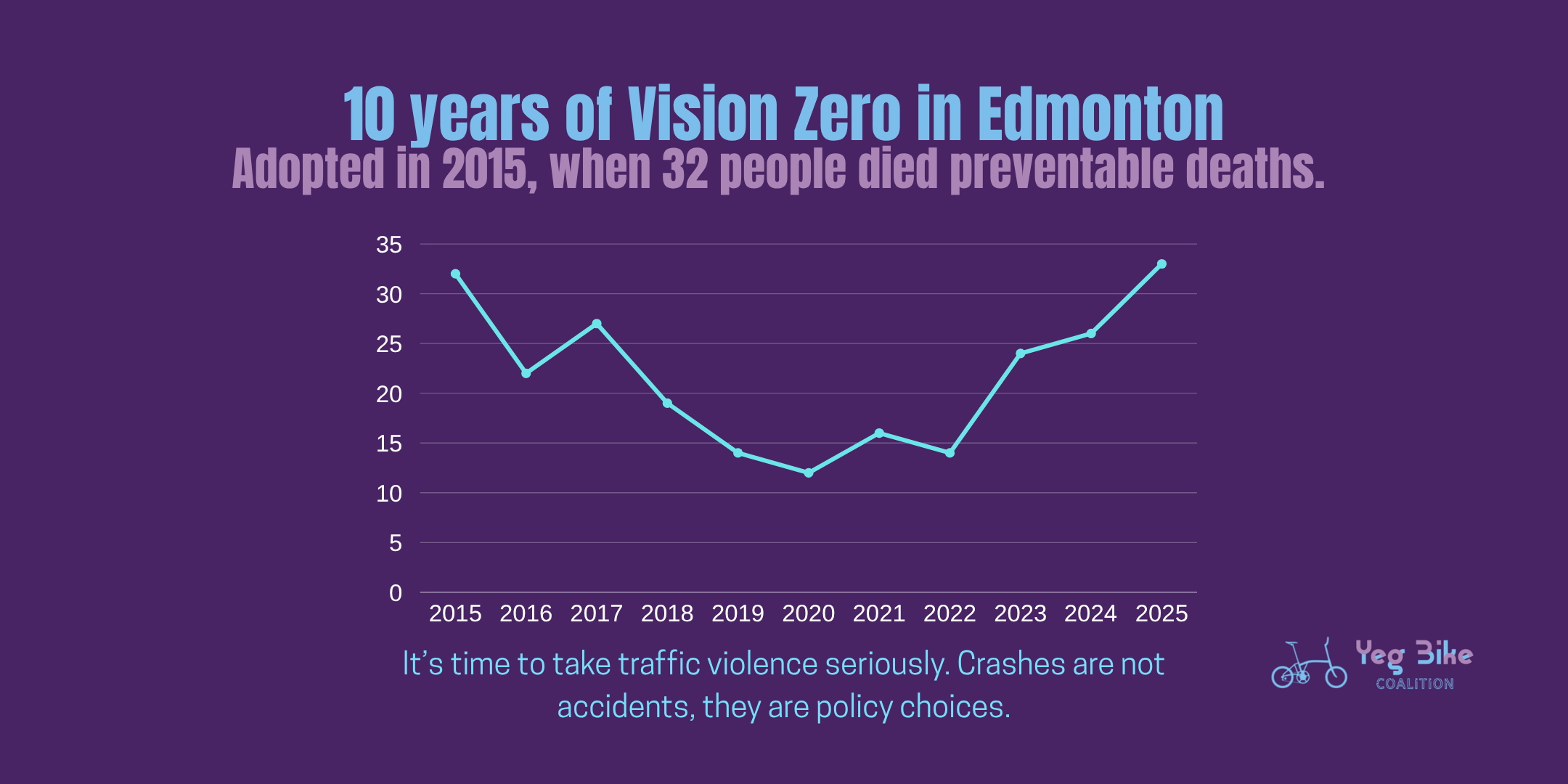
Administration has presented two investment scenarios for 2027–2030: approximately $74 million in capital funding to maintain current delivery, or $150 million for expanded implementation, with additional operating funding.
We want Council to fully fund the expanded Safe Mobility Strategy. The Province's restrictions on automated enforcement have damaged the program's funding model, but that cannot become an excuse to abandon traffic safety.
But funding alone is not enough.
Nothing in the proposed strategy demonstrates a credible path to eliminating traffic deaths and serious injuries by 2032. Council should require Administration to explain how its investments are expected to reduce deaths and serious injuries, and hold the organization accountable for delivering those results.
Edmonton doesn't just need a better-funded Safe Mobility team. It needs a fundamentally different approach to traffic safety across the entire organization.
Related advocacy priorities
Embed Vision Zero throughout the organization
Traffic safety cannot remain the responsibility of one team. Every department involved in designing, constructing, operating, maintaining, and enforcing streets must be responsible for preventing deaths and serious injuries.
-
When a detour plan is being reviewed, it has to ensure that there are safe alternatives for people outside of cars. A bike lane is not an acceptable place to provide free parking to contractors, nor should bike lanes be shut down for festivals, to store garbage bins, or for farmer's markets. The infrastructure should never have been built in a place that it would be unavailable for the entire summer season, but now that it's in, we have to make sure that they remain accessible.
-
Bylaw Enforcement needs to take bike lane and sidewalk obstructions seriously. Allowing businesses to clear snow into bike lanes, allowing delivery drivers to use bike lanes as free parking, or allowing drivers to block accessible parking spots for days on end is simply unacceptable.
- When construction projects remove safety infrastructure, like bollards, intersection treatments, or paint that is intended to ensure that drivers know they are crossing a bike lane, that infrastructure needs to be re-installed immediately after the construction ends.
- "Safe Mobility" projects, like the Safe Crossing program or Towards 40, need a complete re-design. 'Encouraging' people not to speed is not adequate, and prefering signs, paint, and flexiposts over hard infrastructure doesn't achieve desired results.
Review Vision Zero leadership and accountability
The current approach has not delivered the results promised. Some of the City's own safety improvements have left dangerous conflicts in place, with fatal consequences occurring at locations where safety treatments had previously been installed.
People have been killed after the Safe Mobility team installed infrastructure that should be built to prevent deaths. For example, on January 21, 2026, a 78-year-old pedestrian was killed near 115 Street and 107 Avenue, where the City had prohibited crossing on one side rather than providing a safe way for people to make that predictable movement.
We raised serious concerns about this design in our review of the proposed Safe Mobility Strategy while the City told us they did a good job.
We need stronger leadership, clear performance expectations, and consequences when safety commitments are repeatedly missed, or when compromised designs, slow project completions, or other avoidable mistakes are made. The team needs to learn, adapt, and improve. As long as they are unwilling to acknowledge their mistakes, that will never happen. We all make mistakes, that is a key part of improving, and the goal that we all share is that no one should be dying due to traffic violence. This isn't about firing people, reporting them to professional bodies, or pursuing legal action, it's about keeping our neighbours, friends, and family members alive.
Prioritize physical safety improvements and eliminate conflicts
Signs, education, and enforcement have roles to play, but the most reliable way to address dangerous streets is to change their design. The entire purpose of Vision Zero is to build infrastructure that acknowledges that people make mistakes, and to ensure that no one is killed or seriously injured when those mistakes happen.
It is clear that the organization is more concerned about not getting sued when someone is hurt or killed than they do about preventing the collision in the first place. That's the kind of thinking that accepts fatalities and prioritizes inaction. It is not Vision Zero.
Some Towards 40 projects have also introduced conflicts between drivers and cyclists while improving pedestrian crossings. We appreciate those pedestrian improvements, but safety for one group should not come at the expense of another.
Remove dangerous slip lanes and redesign intersections
The proposed Safe Mobility Strategy emphasizes arterial intersections and protected left-turn signals. These can reduce some collisions, but they do not necessarily eliminate the dangerous movements that create them.
We want slip lanes prohibited wherever they conflict with people walking or cycling, with existing urban slip lanes progressively removed. They may be appropriate on controlled-access highways, but they have no place cutting across urban pedestrian and cycling routes.
Protected left turns also require careful design. A leading protected-left phase followed by a Leading Pedestrian Interval can expose pedestrians to drivers who enter late or fail to clear the intersection before the WALK signal appears.
The City must assess entire signal sequences, including clearance times and predictable driver violations. Its first priority should be removing dangerous conflicts, not simply managing them with additional signals.
Eliminate pedestrian beg buttons
At ordinary signalized intersections, pedestrians should receive a WALK signal automatically whenever their crossing phase is served. People shouldn't have to press a button just to be acknowledged as legitimate road users.
At pedestrian-activated crossings, requests should be served promptly. The City should establish maximum waiting times that recognize the experience of someone standing outside in freezing temperatures, rain, wind, or snow.
We should not prioritize a few seconds of convenience for people inside climate-controlled vehicles over the safety and comfort of people waiting outside. Also, accessible audible and tactile signal features must be retained and improved.
Make school safety about children, not cars
School safety should prioritize children walking and cycling to school, not simply managing the congestion created by parents driving their children.
We want investment in safe routes to schools, protected crossings, traffic calming, modal filters, and measures that reduce vehicle access immediately around schools. But minor traffic calming is not enough.
Edmonton should introduce school streets, temporarily restricting non-essential vehicle access during arrival and dismissal, so children can travel more safely and independently.
We also want a Trick or Streets program, temporarily closing streets with high trick-or-treating volumes to vehicles on Halloween. Candy Cane Lane already demonstrates that Edmonton can manage temporary street access for major neighbourhood activities.
These are practical ways to make streets safer for children while giving families more transportation choices.
Use risk-based decisions and respond quickly to serious collisions
Dangerous locations should be identified through evidence, including speeds, traffic volumes, conflicts, and the risks faced by people outside of cars. We shouldn't have to wait for a fatal collision before acting.
When a fatal or serious collision does happen, the City must act immediately to assess the risks and install temporary protections where appropriate. Police investigations can continue without preventing the City from addressing visible dangers.
Consider the cyclist struck by a delivery truck at 81 Avenue and 106 Street on August 25, 2026. She died of her injuries on September 12.
The cycling route at that intersection is effectively a roadside shared-use sidewalk, with the turning conflicts that such facilities create. Crossing markings had also been removed during spring roadwork and, based on our observations, had not been restored before the collision. A micro-surfacing project removed the intersection paint that is intended to address the intersection safety issue. This project happened in the spring, and months later, when this collision occurred, that paint had not been replaced. The City also failed to take advantage of a planned construction project to add traffic calming or improve facilities.
The driver is responsible for the person they killed, but the City failed to ensure that drivers know they need to be watching for fast moving cyclists through that intersection.
Again, this advocacy is not about punishing individuals. It's about building an organization that learns from mistakes and prevents them from happening again. A commitment to Vision Zero requires the City to examine its own role in preventing future collisions, not simply wait for police to determine who broke the law.
The City should have a rapid-response process to assess the location, identify immediate risks, and install temporary protections where appropriate, while police investigations and longer-term design work continue.
EPS also needs to improve the timely sharing of safety information and enforcement of dangerous driving laws.
Coordinate all safety projects and publish the plans
Safe Mobility, ATNE, ATIG, neighbourhood renewal, arterial renewal, and other construction programs must work together.
We want a single, publicly accessible, citywide map showing every planned safety project for 2027–2030, including proposed treatments, funding sources, construction schedules, and connections to other projects.
Residents should be able to see which intersections will be redesigned, where dangerous turns will be removed, and which crossings will be made safer.
Engagement must happen before designs are finalized, with meaningful participation from people walking, cycling, rolling, using mobility devices, and taking transit.
Consultation should identify risks and improve designs. It should not give objections to losing parking or traffic lanes greater weight than documented safety concerns.
Use the enforcement powers we already have
The Province has restricted automated traffic enforcement, but Edmonton still has municipal enforcement powers it can use today. The City can enforce illegal parking, sidewalk obstructions, and requirements for property owners to clear snow and ice.
Enforcement should be proactive, particularly along protected bike lanes, busy pedestrian corridors, and important transit connections.
We are seeking additional parking enforcement funding elsewhere in this budget submission, but Safe Mobility must also coordinate with Bylaw Enforcement and City Operations. A blocked accessible crossing or a sidewalk covered in ice can make an entire route unusable. The City should not wait days for complaints to work their way through 311 before taking action.
Make every construction project a safety project
This is especially important during the 2027–2030 budget cycle, with substantial investment planned in neighbourhood and arterial renewal.
Every reconstruction project should address known safety problems rather than recreate them.
That requires updated Complete Streets standards, effective safety reviews, and accountability when projects fail to meet those standards.
We should not spend millions rebuilding dangerous infrastructure, only to send Safe Mobility back years later to fix what should have been done properly the first time.
5. Protect neighbourhood renewal funding
The Building Great Neighbourhoods program is one of Edmonton's most important long-term infrastructure investments. It renews aging streets, sidewalks, and alleys while creating opportunities to improve safety, accessibility, and transportation choices.
Council has considered redirecting up to 25% of the dedicated neighbourhood renewal levy toward arterial road renewal, potentially shifting approximately $220 million over the next four years.
We oppose taking money intended for neighbourhood renewal to solve a separate funding problem. Council must protect neighbourhood renewal funding and ensure major projects have the resources needed to deliver safe, accessible, high-quality streets.
We support arterial renewal, but its cost should not be hidden within the neighbourhood renewal levy. Council should budget for arterial renewal separately and justify any required tax increase to Edmontonians.
Related advocacy priorities
Protect dedicated funding
Neighbourhood renewal revenues should remain available for neighbourhood renewal, not become a flexible source of money for unrelated projects.
Apply Complete Streets consistently
Every neighbourhood renewal should improve walking, cycling, accessibility, and traffic safety in accordance with the City's adopted standards. Renewal is an opportunity to fix dangerous street designs, not rebuild them for another generation.
Coordinate renewal with other programs
Neighbourhood renewal should deliver planned Bike Plan, Safe Mobility, and transit improvements wherever projects overlap. This coordination should be established before designs are finalized, reducing costs and avoiding the need to reconstruct streets again later.
Fully fund major renewal projects
Complex projects such as Wîhkwêntôwin need adequate funding to deliver the improvements promised, not scaled-back designs that simply replace aging infrastructure. Council should address funding shortfalls rather than sacrifice safety, accessibility, or project quality.
6. Give arterial renewal its own budget
Edmonton's arterial roads need maintenance and renewal, and many are among the most dangerous places in the city. Rebuilding them is an opportunity to improve safety, accessibility, and transportation choices for everyone.
We support arterial renewal, but it needs its own budget. If Council wants to accelerate this work, it should establish a dedicated capital allocation and explain how taxpayers will pay for it.
Taking money from neighbourhood renewal doesn't make arterial renewal cheaper. It simply shifts the cost onto neighbourhoods through delayed projects and deteriorating infrastructure.
Related advocacy priorities
Prioritize renewal over expansion
Maintaining and improving existing roads should take priority over adding lanes that create new long-term maintenance obligations. Council should distinguish the cost of repairing infrastructure from the additional cost of expanding it, and require evidence that any proposed expansion is necessary.
Apply Complete Streets to arterial roads
Arterial reconstruction must improve pedestrian crossings, cycling connections, transit access, and accessibility. Dangerous intersections and roads that divide neighbourhoods should be redesigned to reduce conflicts, not rebuilt with the same safety problems.
Account for the full cost
Council should consider construction, maintenance, snow clearing, and eventual replacement costs before approving projects. Expensive design choices, including preserving parking at the expense of safety or significantly increasing construction costs, must be justified by clear public benefits.
Stop paying a premium to preserve parking
The 50 Street Capilano project illustrates this problem. Administration presented an approximately $2.4 million option and a parking-preserving alternative estimated at approximately $4.9 million. We should not spend millions more to preserve parking without a clear public benefit. Where expensive parking accommodations primarily benefit nearby properties, local improvement funding should be considered.
Address regional drivers' fair share
As discussed above, 32% of vehicle-kilometres travelled on Edmonton roads are driven by regional residents, with the City estimating that accommodating regional traffic requires 47% more road capacity. Most of that happens on arterial roads, so it is vital that we get any arterial renewals right.
Edmonton should pursue fair regional funding arrangements instead of expecting its own taxpayers to keep subsidizing regional driving.
Other advocacy priorities:
Better decisions don't always require bigger budgets
Funding is essential, but many of Edmonton's transportation problems are caused by policies, standards, and decision-making processes.
We will continue advocating for these changes alongside the budget.
Protect local transportation decisions
Edmonton's streets should be designed for the needs of Edmontonians, not provincial political preferences.
We strongly oppose provincial interference that would force municipalities to remove cycling infrastructure or restrict their ability to build safe streets. Removing existing bike lanes would waste public investments, undermine local democracy, and make our streets more dangerous.
Improve public engagement and transparency
Residents deserve meaningful opportunities to participate in decisions that affect their neighbourhoods. We're pleased that Council maintained public hearing requirements for changes to the Neighbourhood Renewal Program, but public hearings are only one part of meaningful engagement.
Too often, the City makes decisions about transportation users without adequately involving the people affected. You cannot design good cycling infrastructure without understanding the experiences of people who cycle. The same is true for accessibility: people with disabilities must be involved in identifying barriers, evaluating designs, and deciding what works.
Engagement should influence decisions, not simply provide a record that consultation occurred. The City needs to listen to people who use its infrastructure, particularly those it claims to be encouraging to walk, cycle, and take transit.
We also want greater transparency when projects fall below Edmonton's preferred design standards. Every decision to use a lower standard should require a written, publicly available justification, signed by the accountable decision-maker. Meeting an outdated minimum should not excuse a design that fails to deliver the safety and accessibility Edmontonians expect.
Fix the City's design standards
Edmonton's Complete Streets Design and Construction Standards need to deliver genuinely safe, accessible infrastructure, not simply improvements over what existed before.
We want 5A-quality cycling infrastructure: Always Available for All Ages and Abilities. That means routes that are safe for children, seniors, and people with mobility limitations; connected across the city; designed for efficient winter maintenance; and available whenever people need them.
Protected intersections, properly separated cycling facilities, safe crossings, and designs that eliminate conflicts should become standard practice. Painted bike lanes and roadside shared-use sidewalks should not be accepted as substitutes where they leave people exposed to predictable dangers.
These standards are essential to achieving Vision Zero, climate targets, affordable transportation, and sustainable growth. Edmonton cannot meet those goals while continuing to design streets primarily around driving and parking.
Standards should also reflect the built environment. What works in the suburbs, especially the newer suburbs, and what works through the core area and mature neighbourhoods is not the same. The rules need to reflect appropriate standards for the developing and redeveloping areas.
Reform how projects are prioritized
Transportation investment should reflect safety risk, network connectivity, population growth, accessibility, and public benefit.
Projects should not move to the front of the line simply because a vocal group objects to losing parking or because a particular road has attracted political attention.
The City should also take greater account of infill, planned housing growth, and connections to LRT and BRT when deciding where to build. Neighbourhoods that are growing from infill need infrastructure to support that growth, especially when safe options to move around the city without a car exist or can be better supported.
Improve construction management
Construction is unavoidable, but unsafe detours, unfinished projects, and missing safety infrastructure are not.
Contractors should be required to maintain safe, accessible routes throughout construction, with proper inspections and enforcement. Bollards, signs, pavement markings, and other safety treatments must be restored as soon as the work affecting them is complete.
The City should prioritize finishing projects before starting more work that disrupts the same transportation network. Construction schedules need to account for the harm caused by prolonged closures, idle sites, and disconnected routes.
Edmonton should also examine whether expanding its own construction capacity would improve delivery, reduce delays, and allow staff and equipment to support winter maintenance when appropriate.
Make accountability part of every decision
Vision Zero, Complete Streets, and the Bike Plan cannot succeed if the departments responsible for delivering them work toward different goals.
City Operations, Integrated Infrastructure Services, Urban Planning, Safe Mobility, and enforcement teams must share responsibility for the results.
We want transparent reporting, clear accountability for decisions, and a willingness to change approaches that aren't working. Successful projects should become models for future work. Failed projects should lead to improvements, not excuses.
The budget should reflect the city Edmonton wants to become
Edmonton faces real financial challenges. We cannot fund everything, and every dollar spent on one project is unavailable for something else. That makes good priorities more important, not less.
We should not spend millions preserving parking while struggling to fund basic safety improvements. We should not expand roads without accounting for decades of maintenance costs. We should not rebuild streets to inadequate standards, only to return years later to correct problems that could have been avoided.
Transportation affordability is about more than property taxes. Car ownership is one of the largest expenses facing Canadian households. A 2026 estimate from Ratehub puts the cost of owning and operating a typical vehicle at approximately $16,500 annually, although actual costs vary considerably.
Driving also carries public costs through roads, parking, maintenance, collisions, pollution, and infrastructure that must eventually be replaced. Those costs are often overlooked when governments compare transportation investments.
A city where people can safely walk, cycle, and take transit gives households more choices, reduces dependence on expensive vehicles, and makes better use of public infrastructure.


Our priorities are about getting better value from public spending while building a safer, more accessible, and more financially sustainable Edmonton.
The City already has many of the plans and policies needed to guide this work. What it lacks is consistent implementation, adequate funding, and accountability when its decisions undermine those plans.
It's time to fund the commitments, build the infrastructure, and deliver the results Edmontonians were promised.
Have your say
The City's proposed 2027–2030 budget is scheduled for release on November 2, with public budget hearings beginning later in November.
We encourage Edmontonians to review the proposed investments, contact their councillors, and speak at the public hearing.
You don't need to be a regular cyclist to benefit from safer streets, better winter maintenance, responsible infrastructure spending, and more transportation choices.
These are investments in the Edmonton we all share.
Learn more: City of Edmonton budget process | Edmonton Bike Plan | Vision Zero and Safe Mobility
